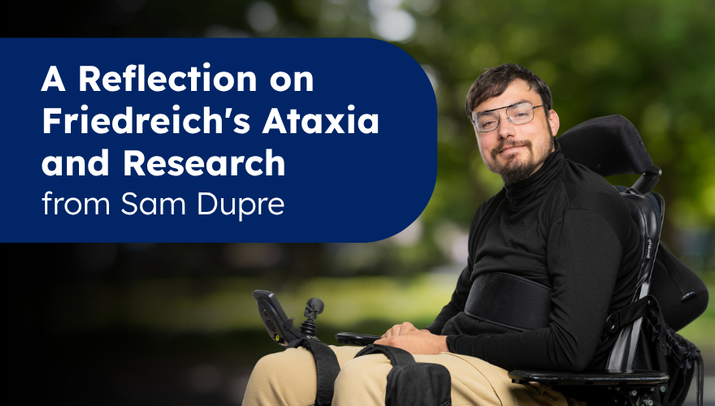
When I was diagnosed with Friedreich’s ataxia at age 10 after five years of questions with no answers, there were still no approved treatments. For more than sixteen years after that, it often felt like nothing was changing. I went through that long denial phase so many of us experience — years of pushing it aside because I didn’t think there was anything that I could do. But I was wrong.
What Friedreich’s Ataxia Actually Does
Friedreich’s ataxia is caused by a change in the FXN gene. In people without FA, this gene has a modest number of GAA repeats — usually around 40. In FA, that number explodes to hundreds or even thousands. This expansion essentially turns the gene “off,” so the body can’t produce enough of a protein called frataxin.
Frataxin’s job is to help mitochondria — the tiny power plants inside our cells — work properly and handle iron safely. Without enough frataxin, mitochondria can’t make energy efficiently. Iron builds up in the wrong places, creating toxic stress that damages cells. The cells that need the most energy are hit hardest: nerve cells (especially in the spinal cord and brain) and heart muscle cells.
That’s why FA is progressive. Over time, the damage adds up — leading to loss of coordination, balance problems, speech difficulties, fatigue, and heart complications. It usually starts in childhood or the teen years and gets worse over the years. Understanding this root problem is why today’s research is so focused on restoring frataxin or protecting cells from the damage it causes.
For a long time it felt like we were stuck with this disease and no real options. But understanding the root problem — not enough frataxin and the damage it causes — has opened the door to real progress. This progress didn’t happen because researchers worked in isolation. It happened because the FA community refused to stay silent or passive. Patients, siblings, parents, and ambassadors have shown up for natural history studies, organized events, raised funds, shared stories, and demanded attention from regulators and funders. Our advocacy built the infrastructure that made today’s pipeline possible.
FARA has been steering this ship with steady hands. That work is powered by the same advocacy. Thanks to their leadership, seed grants, and the community’s willingness to participate in studies and events, the pipeline is more robust than it has ever been, with multiple active therapeutic candidates across different mechanisms. FARA has invested over $104 million in research and helped unlock more than $212 million in federal funding. That leverage exists because advocates turned personal pain into collective action.
How FARA Turns Advocacy Into Action
FARA helps turn our personal stories and determination into real power. They provide training and support for ambassadors, create platforms like rideATAXIA events and Hangouts where we can connect and take action together, amplify our voices with researchers and policymakers, and make it easier for all of us to participate in studies and share our experiences. When we show up, FARA makes sure our collective voice is heard loud and clear.
Targeting the Root Cause
Several treatment approaches are now in clinical trials targeting the root cause of FA — the lack of frataxin protein. These include protein replacement therapies, which aim to deliver a functional version of frataxin directly into cells, and gene addition therapies, which aims to deliver a working copy of the FXN gene to affected tissues such as the heart. Other innovative strategies are advancing as well.
You can explore the complete list of investigational treatments and approaches on FARA’s drug development pipeline page.
FARA also provides many helpful tools and resources designed to make the science more accessible for all of us. Visit curefa.org to explore clear explanations, educational materials, regular updates, ambassador blogs, community Hangouts, and webinars — places where we can learn together, ask questions, and stay informed about the latest progress in ways that feel welcoming and easy to understand.
This diversity of approaches gives the community multiple paths forward and reflects the power of sustained advocacy.
We are not just waiting while life-shortening cardiomyopathy and progressive ataxia do their damage. We are living the daily grind, adapting, showing up for each other, organizing events and Hangouts, writing letters and blog posts, and turning our stories into action that sustains hope while the science advances.
It feels like we are at the beginning of the end. This is no longer a question of if we will cure FA. It is a question of when. None of it happens without us. Our voices, our participation, our events, and our refusal to accept “there’s nothing we can do” are what turned a black box into a pipeline with real momentum.
We’re gaining ground, but we still have work to do.
Here’s what you can do to help finish the job:
Share this update, donate to FARA if you’re able, sign up for a natural history study if you qualify, or show up to the next event. Every action keeps the pressure on and brings us closer to the day when FA is behind us. Just like I finally stepped out of denial and into this fight, your voice and presence matter too.
Together, we will cure FA.
Written by
Sam Dupre