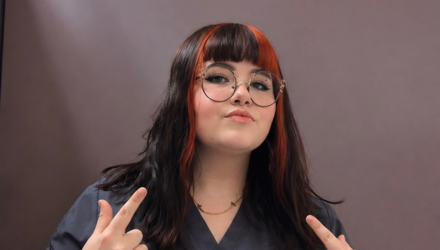
Name:
Abbigale Cuzick
Age:
I am 21 years old.
Where do you call home?
I call Eastern Washington home.
What is your education? What is a current goal you have with your education?
I recently completed my education in Medical Assisting. One of my biggest goals is to continue building my career in healthcare and use my experiences to help me become a compassionate and understanding medical professional. Living with FA has given me a unique perspective on healthcare and what it feels like to be a patient. I hope that perspective will help me better understand and support the people I work with in the future. FA has taught me that everyone has challenges that may not always be visible, and I want to carry that understanding with me throughout my career.
Who do you live with?
I live with my family and my pets. I have two dogs and a cat, who are all ESAs.
What’s a typical day for you?
A typical day for me can look different depending on what I have going on. A lot of my time has been focused on preparing for my future career, and spending time with family and friends.
Living with FA means I have to be flexible and listen to my body, so some days look very productive while other days require me to slow down and rest.
How long have you known you are living with FA? When and how were you diagnosed?
I was diagnosed with Friedreich’s ataxia when I was 13 years old. I ended up going into a severe Diabetic Ketoacidosis that made my body shut down and I had to relearn how to function. I have now been living with the diagnosis for about eight years. As I have gotten older, I have continued learning more about myself, my body, and how to adapt to the changes that come with FA.
Are there any others with FA in your family?
Yes, one of my older sisters also has FA.
Describe your transition from walking to walker/wheelchair.
One of the biggest transitions in my life was going from walking to using mobility aids and eventually becoming a full-time wheelchair user. I have used my wheelchair full-time since about late 2021, when school opened after Covid. That transition was emotional and challenging because it meant accepting changes that I did not necessarily want to make.
What do you like to do to stay active and what type of exercises work for you to stay strong?
I currently do physical therapy once a week while doing a few exercises throughout the day to keep strengthening muscles, but not tiring myself all at once.
Do you have any hobbies or special interests?
I enjoy game time with my family and friends, caring for my animals, exploring new places, and being creative. I also enjoy fashion, drawing and painting, and finding ways to express my personality and style. I am passionate about advocacy and helping others feel less alone, especially within the FA community.
What is a good trick to make daily life easier?
One of the best tricks I have learned is to make adaptations before something becomes too difficult or frustrating. I also try to plan ahead when I can, especially when going somewhere new, because accessibility can make a huge difference. Most importantly, do not be afraid to make your life work for you instead of forcing yourself to do things the same way everyone else does.
When FA gets you down, what do you think/do to feel better?
When FA gets me down, I allow myself to feel my feelings. I think it is important to acknowledge that living with a progressive condition can be difficult and that it is okay to have bad days. I usually feel better when I spend time with the people and animals I love, talk to someone I trust, or focus on something that brings me joy. I also try to remind myself of everything I have already overcome. Some days, simply taking a deep breath and getting through one moment at a time is enough.
What is one way living with FA has POSITIVELY affected your life?
Living with FA has made me more compassionate and understanding toward others. It has taught me not to judge people based on what I can see because everyone may be dealing with something that is not immediately obvious. FA has also connected me with an incredible community. Although I would never choose the challenges that come with FA, I am grateful for the people I have met and the perspective it has given me. It has helped me realize how important it is to support one another and remind people that they are not alone.
What is a favorite motivational quote of yours?
One of my favorite quotes is: “You are stronger than you think.” I like this because there have been many times in my life when I did not feel strong, but I kept going anyway. Sometimes strength is not about doing something huge. Sometimes strength is simply getting up, trying again, asking for help, or continuing even when life feels overwhelming.
What is a piece of advice that someone with FA has given you that encourages and inspires you?
One of the most meaningful things I have learned from others in the FA community is that it is okay to adapt and ask for help. Independence does not always mean doing everything completely on your own. Sometimes being independent means knowing what you need, advocating for yourself, and finding the tools and support that allow you to continue living your life. That reminder has encouraged me to focus less on doing things exactly the way I used to and more on finding ways to keep doing the things that matter to me.
What is the best advice YOU could give to a person who has been newly diagnosed with FA?
Even though things may seem and feel hard at times, it is okay to have bad days, fall down, or feel overwhelmed. Take a deep breath, keep going, and remember that you are not alone. A diagnosis can feel scary and overwhelming, especially in the beginning. You do not have to figure everything out at once. Give yourself time to process, ask questions, and find people who understand what you are going through. Your life may change, but that does not mean you cannot still have dreams, goals, relationships, and a life that you love.
What is the first thing you want to do when a cure/treatment to FA is found?
The first thing I would want to do is take a moment to truly appreciate how far the FA community has come. There are so many individuals, families, advocates, researchers, and supporters who have worked incredibly hard and never stopped hoping.
Personally, I would be excited to experience more freedom and possibilities without having to constantly think about how FA may affect the future. I would also want to celebrate with the people who have been on this journey with me.
“I have FA but FA doesn’t have me.” What does this statement mean to you?
To me, “I have FA but FA doesn’t have me” means that FA is part of my life, but it is not my entire identity. FA affects many things I do and has shaped parts of my journey, but it does not define my personality, my dreams, or my worth. I am still a daughter, a family member, a friend, an animal lover, a healthcare professional, an advocate, and a person with goals for the future. I can acknowledge the challenges of FA while still choosing to live my life and be myself.
How do you live your life in the face of adversity?
I try to take life one day at a time. I do not always have a perfect attitude, and I think it is important to be honest about that. There are days when adversity feels heavy, and I allow myself space to feel frustrated, sad, or overwhelmed. But I also try not to let difficult moments take away all of the good things in my life. I continue making plans, setting goals, trying new things, and finding reasons to laugh. I have learned that courage does not mean never being afraid or upset. To me, courage means continuing to move forward, even when the path looks different than I expected.
Tell us a little more about you….
My name is Abbigale, and I am someone who cares deeply about the people and animals in my life. I am passionate about helping others and making people feel seen and understood. I recently completed my education in Medical Assisting and am excited to see where my future takes me. Living with FA has been a major part of my journey, but it is only one part of who I am. I have experienced challenges, changes, and moments when I have had to rethink what my future might look like. Through it all, I have continued to grow and learn more about myself. I am proud to be part of the FA community and to serve as a FARA Ambassador. I hope that by sharing my story, I can help someone else feel less alone. If there is one thing I want people to know about me, it is that I may do things differently, but I still have dreams, goals, and a full life that I am continuing to build.
Interview by:
Mary Nadon Scott
Edited by:
Brittany Sommerfield