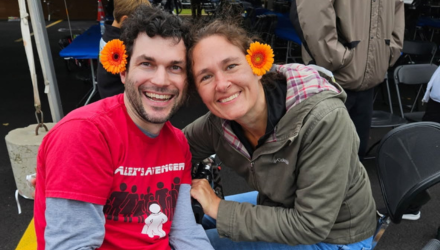
Name: Alex Fielding
Age: 37
Where do you call home? Rhode Island, USA.
What is your education? What is a current goal you have with your education? I have my M.S. in Chemical Engineering and work for my family’s manufacturing company, founded by my grandfather.
Who do you live with? I am a proud homeowner and live independently with my dog Mia.
What’s a typical day for you? I wake up and take time to stretch and get moving; the “getting going” is tough with FA. I go to work and spend the day working with our team between the office and shop floor. I get home late in the evening; when it is warm out, I will take Mia for a “walk” around my neighborhood on my trike. My favorite part of the day is lying down on my large area rug, stretching and doing light exercises with the news on in the background. Then I warm up dinner (I try to cook one or two big meals to have for the week). I’ll check emails and connect with friends while I eat. Then any light house chores and a shower before winding down. I’ll watch a TV show, read a book, or play video games with a snack before bed.
How long have you known you are living with FA? When and how were you diagnosed? In my mid-20’s, I was out on my own and starting my career. I enjoyed adventures with my friends most weekends, including sports, hiking, camping and being outdoors. One weekend, we hiked on of the 4,000 foot mountains in NH – towards the summit, I felt tired and unsure of my balance – the hike back down was stressful and slow. That event (coupled with other concerns in my day-to-day life) prompted me to seek answers. Two years later, two states, two neurologists and too many diagnostic tests, I was finally tested for genetic ataxias. I have lived with the knowledge of FA for 11 years now.
Are there any others with FA in your family? Just me. Some of my siblings are confirmed carriers, but only I have FA.
Describe an adaptation and/or transition you have had to take due to living with FA. When I was first diagnosed, I kept walking unassisted. Then, I started using a cane in public – despite what most people thought, the cane didn’t help me walking but served as a visual cue to others that I have mobility issues. Currently, I use a three-wheel rollator for quick trips around town (it is lighter and more compact to keep in my car). At work I use a standard four-wheel rollator (it’s sturdier, provides more support, and offers a seat when I’m working on something and need to stop and focus). At home I use my desk chair, retrofit with large casters to roll easier (it provides something to hold on to and I can place items on the seat instead of having to carry things). The challenge lately has been travelling – I use an electric travel scooter to travel long distances (i.e. airports, city blocks) where a rollator would tire me out. But the trade-off is the scooter takes time to break down/setup whenever I get in a car and is bulky in tight quarters (like a hotel room or office building). I just got a power rollator with a seat so I can use it as a standard rollator in buildings and confined areas, but when I need to go longer distances, I can sit down and use it as a powered transport chair. I just had my first travel experience with it this weekend (domestic flights and getting around a city) – it was a perfect hybrid! I just hope it’s built to survive my travel schedule!
What do you like to do to stay active and what type of exercises work for you to stay strong? I do yoga, daily stretching, and body-weight exercises to maintain core strength and challenge my coordination. When the weather is nice, I like to take my recumbent trike for long rides along the water in RI. Also going to work everyday and being on the shop floor is good to stay active and moving.
What is a good trick to make daily life easier? For me, food is the biggest energy drain and mental stressor in my life. I like to cook and eat healthy, but shopping, loading the car, unpacking, prepping, cooking, cleaning, … for one person every day is exhausting! I’ve developed some easy meals and ingredients that I can prep once or twice per week. I take advantage of curbside grocery shopping a lot but have learned which items you can trust to a shopper, and which items will suffer in quality if you don’t pick it out yourself. I occasionally get prepared meals delivered through a weekly subscription and use one of the food delivery apps when I’m really running low on energy. It does take some discipline because delivered meals are great, but they are expensive and typically less healthy. So, I’ve learned to use it as a tool in my weekly shopping and meal planning, rather than becoming dependent on it.
When FA gets you down, what do you think/do to feel better? Typically, I eat a big meal, put on a good movie or album, and lie down with my dog. Getting myself distracted and “out-of-my-head” is key. Just letting myself rest or sleep typically resets my thinking and lets me start the next day “fresh.”
What is one way living with FA has POSITIVELY affected your life? With FARA and my connections in the FA-community, I have met an unbelievable amount of amazing people. I feel like lots of people only interact with those in their immediate circle or engage with others like them. With FA, everyone comes from different walks of life. We have a common diagnosis, but unique dreams, ambitions, interests, personalities, communication styles, backgrounds, talents, etc. Bringing so much variety together creates new experiences that I would not have enjoyed in my own silo.
What is a favorite motivational quote of yours? There is a Japanese proverb that loosely translates to “Fall seven times, get up eight.”
What is the best advice YOU could give to a person who has been newly diagnosed with FA? Meet people. Learn about scientific progress and the current state of drug development. Draw strength from others. Engage when you are ready. FA is already extremely lonely – don’t compound that isolation by closing off to the world. You’re not the first, last, or only person living with FA. Learn from others and allow them to learn from you.
What is the first thing you want to do when a cure/treatment to FA is found? The list is becoming unrealistically long! In addition to traveling abroad and exploring more exotic places, I’d like to earn my pilot license and rebuild an antique car.
“I have FA, but FA doesn’t have me.” What does this statement mean to you? I’ve met so many people in my professional and personal life that are dealing with some hardship; cancer, chronic illness, dysfunctional family environment, mental health challenges, financial hardships, career crises, loss of a loved one, etc. I don’t define any of these people by their challenges. I know them because of their character, personality, relationship with me, and all the positive things they do. FA is my hardship and while it affects how I can do things, I don’t let it affect who I am and what I can provide for others.
How do you live your life in the face of adversity? Embracing that the only constant is change. Change is one of the hardest things to deal with, yet it’s the most common thread in FA. Many times, change brings about negative things; further progression, loss of abilities, updates to family/friend relationships, etc. However, I remind myself when I’m in these ruts that change also brings positive things. I just keep moving forward, knowing that the pendulum always swings back.
Interview by
Alyx Holliday