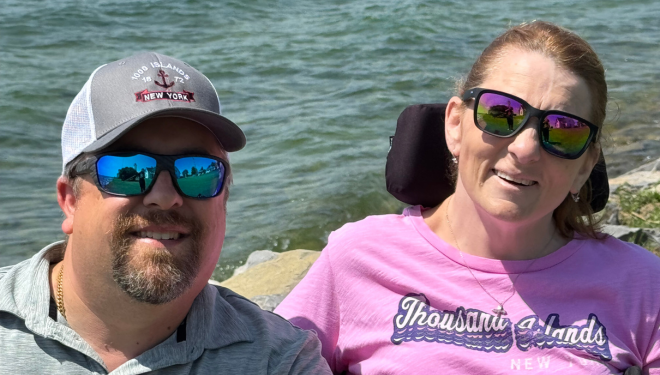
Name: Christina Laurin
Age: 46
Where do you live/who do you live with? I live in Spring, TX, with my husband and our two sons – ages eighteen and fifteen – and our three cats.
Education: BS in Business from Liberty University.
What is your diagnosis story? My journey with FA began long before I understood what it meant. When I was three, my parents noticed I was clumsier than other children. Our pediatrician brushed it off as normal development, prescribed saddle shoes, and suggested gymnastics to help with balance. But the clumsiness didn’t go away. At nine, I underwent a battery of tests at St. Christopher’s in Philadelphia—an EMG, a spinal tap, and a four-hour MRI. The neurologist suspected FA, though this was before the gene had been discovered. His delivery was harsh and devastating: he told my parents the disease was untreatable, that I’d be in a wheelchair by 20, and dead by 40. My parents refused to accept that answer. They sought a second opinion at CHOP, where I was diagnosed instead with CIDP. For three years I was treated with prednisone, which left me with a broken hip and back. Methotrexate followed, causing liver failure. Then cyclosporin, which caused kidney failure. Eventually, we stopped all treatments and simply waited to see how I would do. By then, the FA gene had been identified. I was tested, and the original diagnosis was confirmed. Because I was adopted, I don’t know whether anyone else in my biological family had FA. What I do know is that my story is uniquely mine.
Describe your transition from walking to wheelchair. Throughout high school, walking became increasingly difficult. I was slow, unsteady, and fell often. I began using a wheelchair for long distances like malls or outdoor events, while still walking at school. That changed the day I was knocked over during a fight between two students in the hallway. I realized then that I needed a walker for safety. By 20, I was using a manual wheelchair almost full-time. A decade later, the strain of pushing myself everywhere caused significant shoulder problems. My husband had to push me, and I felt my independence slipping away. Transitioning to an electric wheelchair restored that independence, and it’s what I still use today.
What is your daily life like? My days begin at 7:00 a.m. My husband heads to work, my boys go to school, and my caregiver arrives. I get dressed, do my hair and makeup, and take on whatever the day requires: doctor appointments, housework, laundry, groceries, phone calls, errands, or shopping. I also help another person in my community who has FA and whose condition is more advanced than mine. Serving him is one of the ways I live out my faith. When my family returns home, we eat dinner together and dive into our evening routines. We are Christians and are deeply involved in our church. Our youngest is active in youth baseball, and our oldest is involved in art, so our lives are full, busy, and rich with purpose.
What are some tips and tricks that you have found to make life easier? One of the best tools I’ve found for daily life is a sit-to-stand lift, recommended by a physical therapist. Before that, I had never heard of such a thing. Unlike a Hoyer lift, it lifts by the arms and allows me to stand. It has been essential for my quality of life, helping me transfer, use the bathroom, and stand for exercise, while also making things easier for my husband and caregiver. When FA weighs heavily on me, I turn to my relationship with Jesus. I know He loves me, that He is beside me, and that my suffering is not without purpose. I also think of my boys. Being their mom gives me strength. Living with FA has taught me to take less for granted and to be content with what I have. My favorite verse, Philippians 4:13, “I can do all things through Him who strengthens me” is more than a quote; it’s the foundation of how I live.
What does “I have FA, but FA doesn’t have me” mean to you in the face of adversity? To me, that means I am defined by who I am, not what I have. There is a whole human being behind the diagnosis, someone who loves shopping, plants and flowers, golden retrievers, crafts, and spending time with her husband, sons, and parents. Someone who finds joy in small wins and appreciates the little things.
What is some advice you’d give to someone newly diagnosed with FA? If I could offer one piece of advice to someone newly diagnosed, it would be this: Don’t sit down, or you’ll never get back up. Don’t let your life be defined by your diagnosis. FA is part of my story, but it is not the headline. My life is full of faith, family, purpose, and resilience, and I choose to live it with gratitude, strength, and hope.
Interview by
Jamie Plourde
Edited by
Breanne Lessard