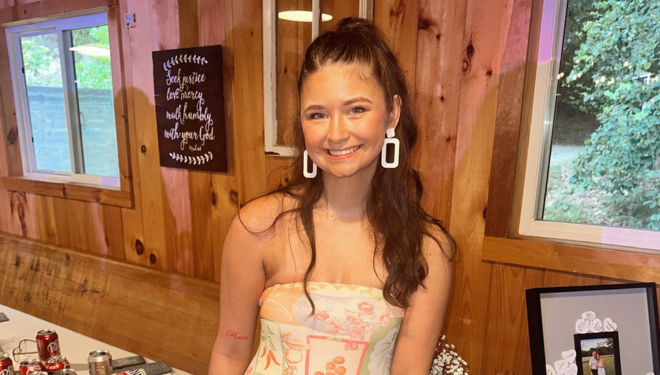
Name: Destiney Key
Age: 24
Where do you call home? Northwest Georgia/Tennessee state line
What is a current goal you have with your education? How will FA add to your future career? I originally planned on being an International Flight Attendant, but due to my FA diagnosis I have still not decided my next career. I believe FA will add a perspective, compassion and understanding that not many people live through with whatever career I eventually decide.
Who do you live with? I currently live with my family and our cat, Tiny. My goal is to move out soon and live independently and to get a dog!
What’s a typical day for you? My day usually starts with driving to get coffee (almost always Dunkin’ IYKYK haha), breakfast, and a plan—but flexibility always wins. Living with FA has taught me patience, creativity, and the importance of humor. I focus on what I can do, stay present, and find joy in the little things. Throughout the day, I focus on what I can do and on the people and moments that matter most to me. I try to stay present and give myself grace, especially on harder days. By the end of the day, I reflect with gratitude. Life with FA isn’t always easy or predictable, but it’s still full of joy, meaning, and moments worth celebrating.
When were you diagnosed and how long have you known you are living with FA? I was diagnosed with FA in February 2021. It was recently my D-day of 5 years!
Are there any others with FA in your family? I have no other family with FA. I’m the first and only!
Describe how you’ve adapted to the mobility challenges presented by FA. Since being diagnosed, I started off getting from place to place very clumsily. I would bounce off things to push myself forward, then I would hold a family member or friend’s arm. Now I use crutches to get around, which for me has kept my independence and strength in my core and legs — to me, that is very important.
What do you like to do to stay active, and what type of exercises work for you to stay strong? I stay active by planning my day a day ahead of time so I don’t run myself past my capabilities, and to always plan rest breaks. My favorite exercises are watching Yoga/Pilates on YouTube and adapting them to do at home. Any bar exercises are really good for me so I have something to hold onto to know I’m safe and don’t have to worry about falling but remaining on my feet so I still keep the coordination the best I can in my legs. I remind myself “if you don’t move it, you’ll lose it.” That goes for anyone, but very crucial with having Friedreich’s ataxia.
Do you have any hobbies or special interests? A hobby I recently have gotten into is bedazzling rhinestones (for example, I recently did a lipstick cap & medication cap). I also really enjoy traveling/roadtrips, aquariums and spending time with animals. I love to read my Bible and non fiction romance books or dystopian books, tan outside during the summer, shopping/thrifting, taking pictures/getting my picture taken, listening to worship or country music and spending time with good people. Quality> quantity.
What is a good trick to make daily life easier? A good trick to make life easier with FA is to always be down to trying something a different way and to not be afraid to ask for help. Always adapt and overcome.
When FA gets you down, what do you think/do to feel better? When FA gets me down I think of the quote “be where your feet are,” meaning don’t think about tomorrow or the future, just be where you are in that current moment. The best thing I do with a bad FA day is laugh it off. If I don’t, it could make or break the rest of my day. But the most important thing to me is taking a moment to breathe and pray and talk it out with the Lord.
What is one way living with FA has POSITIVELY affected your life? Having FA has positively impacted my life by teaching me to cherish each day and memory even more than I did before I was diagnosed. It’s slowed me down, but not in the ways that truly matter. It’s shown me what truly matters and has positively impacted my perspective on the world on how it’s truly a blessing to be here and that growing older is a privilege. Something I would’ve never understood to this level without this diagnosis.
My journey so far has greatly impacted me in the best way of knowing I’m inspiring others that if I can do something so can they, and to be grateful for a healthy body, and putting themselves to the best of their ability. It’s really incredible knowing that throughout this journey, instead of it turning me away from my faith, it made my faith so much stronger and to know I’m a positive example of going through trials and still having faith brings people to wanting the same relationship with Jesus.
What is a favorite motivational quote of yours? My favorite verse that’s very motivational to me from the Bible is 1 Corinthians 16:13-14: “Be on your guard; stand firm in the faith; be courageous; be strong. Do everything in love.” Meaning to stay alert, stay faithful, be brave and strong—but let love be the motive behind everything you do.
What is a piece of advice that someone with FA has given you that encourages and inspires you? One of the most meaningful pieces of advice I’ve received from someone living with FA was, ‘This disease may affect my body, but it doesn’t define my calling.”
They reminded me that God’s purpose isn’t limited by physical ability, and that faith becomes deeper when strength looks different. That perspective encouraged me to trust God daily, focus on what I can still give, and believe that even in weakness, His work is still being done.
What is the best advice YOU could give to a person who has been newly diagnosed with FA? What I’d want to share with someone newly diagnosed is that your feelings are valid, and there is a large community of people that want you to reach out. You’re not alone. Take all the time you need before you’re comfortable with reaching out.
When I was first diagnosed, I couldn’t search anything or talk to anyone with FA until I was ready. I’d say about 6 months in, I found a girl friend with FA that had similar progression. She even encouraged me to join a natural history study to help give research to help on finding a possible treatment.
What is the first thing you want to do when a cure/treatment to FA is found? The first thing I want to do when a treatment/cure is found is I want to train to run in a marathon, finish my dream of becoming an international flight attendant, and to finally be able to fully play with my nieces and nephews again. My little sister (6) can’t remember when I could hold her independently standing, I know she can’t wait for the day when I can fully be there for her and not constantly be fatigued.
“I have FA, but FA doesn’t have me.” What does this statement mean to you? That statement means to me that although I am in the newish world of being disabled, I’m still the same inside and that will never change. FA really is a small part of my life. I’m a child of God, and a diagnosis will never change that.
How do you live your life in the face of adversity? Anchoring myself to something unshakable. When circumstances change, having a foundation—faith, core values, or purpose—keeps me steady. For me as a Christian, that anchor is Christ and the truth is found in scripture. I can’t control what happens to me, but I can control my attitude, choices, and response. Courage often looks like obedience and integrity in small, unseen moments.
Letting adversity refine, not define, me. Isolation makes adversity heavier. Community, prayer, honest conversations, and asking for help are signs of strength, not weakness. I can choose hope daily. Hope isn’t denial—it’s trusting that pain is not the end of the story. For me, as a believer, that hope is rooted in Christ, not circumstances. In short, what I want someone to take from how I feel about adversity is to live faithfully, love boldly, endure patiently, and trust that adversity has purpose—even when you can’t yet see it.
Tell us a little more about you…. A little bit about me is I think everything is funny, and I love to find joy in the small things. I have 4 siblings – one brother and three sisters. I’m a middle child through and through. I’m a proud auntie of 6 nieces with a bonus niece and 2 bonus nephews. I grew up in a small town and currently still live here. I love the beach just as much as I love the mountains I live in.
My favorite seasons are spring and summer. I’m an introvert but extroverted with my people. I’ve struggled with social anxiety and public speaking but I’ve gotten way better recently, and I pray one day I can say I used to be like that. My family didn’t grow up going to church, but at a young age I decided I wanted to go. I’m very stubborn and that’s definitely passed down from my family. I saw myself in my late grandmother, Marty, and I see myself in my great grandmother, Mary-Ann. I’ve always admired her strength and perseverance, even now as she’s in hospice. She is fighting and strong.
Lastly, I’ve always had a greater calling with animals. Mainly dogs for me. They love you no matter what— even on your worst days, without judgment or expectations, they remind you what pure love looks like, when the world feels heavy, they stay close. There’s something so special to me about dogs but animals in general.
Interviewed and Edited by
Noah Griffith