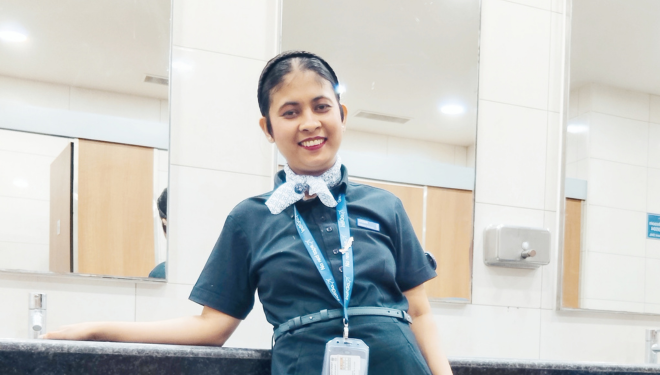
Name: Laxmi Singh
Age: 26 years old
Where do you call home? I call New Delhi, India, home.
What is your education and what are your current goals? How has FA shaped your future career? I completed my 10th and 12th grades, followed by graduation. I also finished a teaching course and qualified for the government teaching examination. Currently, I have cleared the IndiGo Airlines interview and training, and I am working as an AO&CS Officer. My current goal is to continue learning and building skills that help me grow professionally. Living with Friedreich’s ataxia has taught me resilience, adaptability, and empathy. Understanding FA more deeply helps me advocate for accessibility and inclusive support in my workplace. As an AO&CS Officer at IndiGo, this perspective allows me to serve passengers with special needs with greater care and to contribute to a more inclusive aviation environment.
Who do you live with? I live with my family.
What does a typical day look like for you? My routine is simple. I go to the office, come home, and talk a lot with my sister about how my day went. At home I use a walker to help me walk safely and stay independent. At the office I use a power wheelchair to cover longer distances. I also do exercises to stay active, share videos of this on my Instagram, and try to eat healthy food.
How long have you known you are living with FA? When and how were you diagnosed? I was diagnosed with FA in 2020. That’s when I first started needing support to walk, and that’s when I began my diagnosis journey. Because I live with FA, I understand what other FA patients go through. I know the challenges we face. If there is ever a cure in the future, I will never forget this experience because it taught me to understand others’ problems.
Are there any others with FA in your family? My sisters have FA as well.
Describe an adaptation or transition you have made due to living with FA. Due to Friedreich’s ataxia, my mobility has changed over time. I transitioned from needing a wall support to walking independently, then to using a walker for support and balance. I now use a wheelchair at my workplace and for long-distance travel to conserve energy and maintain my independence. This adaptation has taught me problem-solving and resilience. I have learned to use assistive devices and accessibility resources to continue my education, work, and daily life. It has also given me deeper empathy and a strong perspective on inclusion, which I bring to my role as an AO&CS Officer.
What do you like to do to stay active, and what exercises work for you? To stay active, I do balance exercises that help with stability and coordination. I also practice yoga and meditation because they help me stay strong, flexible, and calm. It’s a routine that supports both my physical health and my mental well-being. Sharing thoughts with my siblings and parents gives me a free and relaxing feeling.
What are your hobbies or special interests? My hobbies include playing chess, singing, writing, reading, and talking with others. I love how chess challenges my mind, and how writing, reading, and singing let me express my thoughts and emotions. Connecting with people through conversation is also something I really enjoy.
What is a good trick to make daily life easier? I break tasks into smaller chunks and rest between them. For example, I get ready, then sit for five minutes before heading to work. I use my wheelchair for long distances, which saves energy for the things that matter, like work and hobbies.
When FA gets you down, what do you do to feel better? I focus entirely on what I can control right now and actively let go of what I cannot.
What is one way living with FA has positively affected your life? FA has made life harder in some ways, but it has also made me more resilient, more creative with solutions, and more compassionate toward others.
What is a favorite motivational quote of yours? “Focus on what you can control, and let go of what you cannot.”
What is a piece of advice that someone with FA has given you that encourages and inspires you? Love yourself no matter what.
What is the best advice you could give to a person who has been newly diagnosed with FA? Start balance exercises, yoga, and work with a physical therapist or occupational therapist now. Use tools like walkers or a wheelchair to conserve energy, eat healthy food, stay strong, and remain positive. Do great things in school, college, and work.
What is the first thing you want to do when a cure/treatment for FA is found? I will dance and practice karate again.
“I have FA, but FA doesn’t have me.” What does this statement mean to you? It’s a reminder that even when things are frustrating and hard, I still have control over my attitude, my effort, and how I show up for myself and others. I am living with FA, not being lived by FA.
How do you live your life in the face of adversity? I live by focusing on what I can do, not on what I can’t. Some days are frustrating, but I’ve learned to adapt, pace myself, and find strength in the small wins. Adversity has taught me resilience and empathy. It has reminded me that I’m more capable than I thought, and that attitude makes all the difference.
Tell us a little more about you. I’m positive, caring, a little possessive about the people I love, understanding, motivated, and hardworking. I know I’m not perfect, but I always do my best.
Interview and Editing by
Sam Dupre