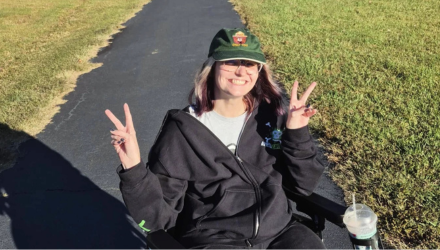
Name: Lily Pierce
Age: 32
Where do you call home? Summerfield, NC.
What is your education? Bachelor of Arts Degree in English from UNCG.
Who do you live with? My family.
What’s a typical day for you? A mixture of staying home and writing, going on nature walks, getting out and about, exercising, attending events (like sports games or concerts) and/or relaxing and watching TV.
How long have you known you are living with FA? When and how were you diagnosed? I started exhibiting symptoms at age 11. I went to multiple doctors and had several tests done over the next five years, but no one could figure out what was wrong. I went to the Mayo Clinic at age 16 for three straight days of testing, and they confirmed my FA diagnosis with a genetic test.
Are there any others with FA in your family? No.
Describe your transition from walking to walker/wheelchair: By age 19, I was falling a lot and hardly able to get around my college campus. As a result, self-consciousness and anxiety constantly plagued me. I took one year off from school because I felt unsure about my major (Marketing) and my walking was so unstable. During that year, I got a rollator walker and tested it out (FYI, I could still drive). I realized how FREEING a mobility aid can be. I returned to school the next fall with a new major (English), a new walker, and most importantly, newfound confidence. After a few more years of disease progression, it got to the point where I often sat in the seat while someone pushed me. So, I transitioned to a manual wheelchair. Once again, I enjoyed the freedom of being able to roll myself. Nowadays, I use a manual and an electric interchangeably. I really appreciate the independence an electric wheelchair gives me (plus being able to go over rocky or grassy terrain).
What do you like to do to stay active and what type of exercises work for you to stay strong? Riding an exercise bike for cardio, dumbbells or gym machines for strength training. But with FA, almost anything can be an exercise if it raises your heart rate and encourages muscle memory. Ex: using a grab bar in my house to stand up and sit back down in my wheelchair repeatedly.
Do you have any hobbies or special interests? I love writing in all forms – blog posts, poetry, songs, etc. Fun fact: I have 100+ houseplants, but I rarely buy them. I mostly propagate old plants and grow new ones.
What is a good trick to make daily life easier? Be generous with the phrases “thank you,” “I love you,” and “I’m sorry.” (Most FA’ers need either a little or a lot of help, so maintaining gracious, respectful relationships with our caretakers makes life easier).
When FA gets you down, what do you think/do to feel better? Listen to music (preferably pop punk), go for a stroll outside, work out, write, paint, pray and/or call a friend.
What is one way living with FA has POSITIVELY affected your life? I’ve met awesome people I wouldn’t know otherwise. Also, it puts me in a unique position where my natural light shines a little brighter. I’d probably share pictures of myself at the park smiling and throwing up peace signs even without FA. But doing so from a wheelchair has a different effect. It warms my heart to know I positively influence people.
What is a favorite motivational quote of yours? Life doesn’t have to be perfect to be wonderful.
What is a piece of advice that someone with FA has given you that encourages and inspires you? Softness opens doors that force cannot move.
What is the best advice YOU could give to a person who has been newly diagnosed with FA? Firstly, exercise as much as possible, and secondly, mobility aid = freedom. Thirdly, rather than lamenting what you can’t do, be grateful for every ability you still have.
What is the first thing you want to do when a cure/treatment for FA is found? Take some dancing lessons or try my hand at basketball.
“I have FA but FA doesn’t have me.” What does this statement mean to you? I have a disability that affects most facets of my life, but I’m still “me” and still trying to live my best life. I just make adjustments based on my limitations.
How do you live your life in the face of adversity? The Serenity Prayer: “God, grant me the serenity to accept the things I cannot change, the courage to change what I can, and the wisdom to know the difference.” As my condition progresses, what I must accept vs. what I can change looks different. But there is still so much I CAN do, like choosing to work out and eat vegetables, or choosing to find joy in the little things. If you think that way, you don’t have to give into hopelessness.
Interviewed By