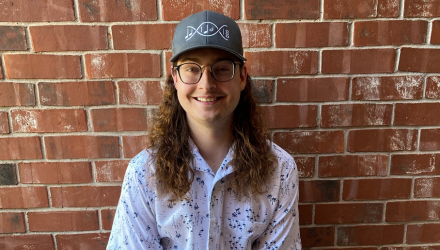
Name: Michael Gehr
Age: 25
Where do you call home? Oklahoma City, OK, USA
What is your education [degree(s)]? I graduated from high school (in Oklahoma) in 2018 and from Washington University in St. Louis (in Missouri) in 2024.
Who do you live with? I live alone.
What’s a typical day for you? I don’t really have a “typical” day right now, as I recently moved out of my parents’ house (in the suburbs of OKC) to an apartment in the city, and I’m still getting furniture and learning what I need to get around and get by on my own. I stay fairly physically active and very active within the FA Community; I co-lead the FA Hangouts (curefa.org/fahangouts) and have started an annual FA fundraiser, the Cure FA Soirée (curefasoiree.org), with my family, so I work on those when I can or when needed.
How long have you known you are living with FA? When and how were you diagnosed? I was a clumsy kid, but we never addressed it until 5th grade (when I was 10) when my teachers expressed their concern to my parents because I was unable to keep up on a school trip. I saw a neurologist and underwent some tests in the summer of 2011, and I was diagnosed with Charcot Marie Tooth in December. As I understand it, many symptoms overlap, but CMT is a less harsh version of FA. Also, some types of CMT can’t be diagnosed with a blood test, so when my test came back negative (unbeknownst to me), it was assumed that I had one of the types for which a test wasn’t conclusive. My misdiagnosis was understandable and I certainly harbor no ill will, and it might’ve even been beneficial mentally – because I had a middle ground between what I thought was a “normal” childhood and adulthood with FA.
At my annual follow up in December 2015, I was told my CMT was progressing faster than expected. I underwent more tests then, and my family went on vacation during which my parents identified FA as something that seemed to match up well (it even explained my scoliosis, which was a question mark when I “had” CMT). On January 19th, 2016, I was diagnosed with FA.
Are there any others with FA in your family? I’ve recently learned that I do have some distant family with FA, but we aren’t clearly genetically related (as far as I can tell) so it’s apparently just by chance.
Describe your transition from walking to walker/wheelchair. I was diagnosed as a sophomore, stumbled through my junior year of high school, and I began using a manual wheelchair most of the time during winter break of my senior year, in December of 2017. I still use a manual wheelchair, though I poorly maintained a SmartDrive (power assist) during college and may look into something similar now that I’m on my own again.
Do you have any hobbies or special interests? I really like music. My parents met in a singing group in college, and my brother and I grew up in talent shows and musicals. As FA affects the voice, my singing ability has gradually decreased. I no longer perform, but I listen to a ton of music, at least 5 hours a day most days on Spotify. Classic rock is my most common genre, but I like everything from musicals to country.
What is a good trick to make daily life easier? Putting on a zip up jacket from a wheelchair? Set it unzipped on your lap where the inside is facing you, put your dominant hand in its sleeve (opposite your dominant side when the jacket is facing you) and grab the inside of the sleeve, cross your non-dominant hand over the dominant one, put it in its sleeve and grab the inside of the sleeve, swing your non-dominant wrist over your head, and extend your arms.
When FA gets you down, what do you think/do to feel better? Talk/vent to someone about it, ignore it, or go to sleep.
What is one way living with FA has POSITIVELY affected your life? I’ve met some incredible people (that I wish I hadn’t met) because of FA.
What is a piece of advice that someone with FA has given you that encourages and inspires you? Because we’re friends (I hope he would agree), I have no choice but to say “life is about how we react” -Kyle Bryant
What is the best advice YOU could give to a person who has been newly diagnosed with FA? Lean on the FA Community. We’ll be there for you as much as we can.
How do you live your life in the face of adversity? I’m not sure how to answer this, but I do want to address it. The truest answer is “I don’t know.” A cop-out answer that I don’t like is “There are different things that work for different people.” What a non answer, it’s equally as helpful as “I don’t know.” One strategy to cope with a life in the face of adversity is to address some aspect of that adversity. I do this by fundraising for FARA and building the FA Community.
I became interested in fundraising soon after my FA diagnosis (in 2016). I hosted a screening of The Ataxian in 2017, and my family’s first Cure FA Soirée was in 2018. Drawing on our love of music (and Kyle Bryant), the event’s tagline is “React with Music.” We describe the soirée as “a night of the arts benefiting FARA,” and the structure is gala meets talent show. Those first two events raised almost $100K for FARA, and the 2nd through 8th Soirées raised over $2 million. In 2025, we had 35 folks with FA at the Soirée, making ours in Oklahoma the 2nd largest FA Community gathering in the world. We make an effort to make the Soirée accessible to FAers/FAmilies through our Travel Grant Program (travelgrant.curefasoiree.org), but not everyone is able to make the trip. Another way to strengthen the FA Community is with the FA Hangouts, video calls for adults with FA. Sydni Gibson-Dupre and I co-lead a team that’s devoted to building the community and supporting folks who attend the twice monthly meetings as we do our best to navigate life with this frustrating and unfair condition. (I gave the link before, but learn more at curefa.org/fahangouts.)
Interview by:
Brittany Sommerfield