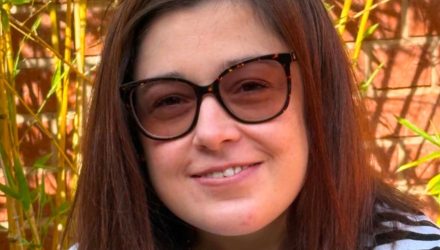
Name:
Natalie Baker
Age:
36
Where do you call home?
England, UK
What is your education? What is a current goal you have with your education? How will FA add to your future career?
I have a degree in psychology. It’s science-based, and it taught me a lot—mostly that I’m not a sciencey person, which changed my career goals. I’ve been thinking about starting a creative writing course ever since, but it’s never been the right time.
Who do you live with?
My parents and my dog.
What’s a typical day for you?
I’ve been dealing with illness for the past couple of years, so hopefully this will change soon. I get up and do about half an hour of stretches because right now I’m in pain if I don’t. Then I eat. Then I do exercise. Then I eat again, and attempt to be sociable or read or play chess. Then I go to bed. Sometimes I mix it up and change the order.
How long have you known you are living with FA? When and how were you diagnosed?
I always knew there was something ‘wrong’ with me. I was just shaky for years, which progressed to things like not being able to do handstands and things like that. My cartwheels were awesome though. I was finally diagnosed at 12. The diagnosis didn’t really have much of an impact on me, to be honest.
Are there any others with FA in your family?
No.
Describe your transition from walking to a walker/wheelchair.
I managed walking throughout school, but it was starting to get difficult. Then I had my spine fused at 17 and from then on used a wheelchair outdoors. I found walking aids impossible to use. I was walking around the house all of the time to begin with, then I started needing my chair more and more over the years. I’d say I was a full-time wheelchair user at about 26 or 27.
What do you like to do to stay active, and what type of exercises work for you to stay strong?
I have believed for a long time that a lot of the problems associated with FA are due to lack of exercise, so it’s a big part of my life. I do a lot of Pilates-style exercise and low-weight training on my arms and back. Mostly I stay active by just being incredibly stubborn and trying to do things myself.
Do you have any hobbies or special interests
Fitness. I also read and listen to a lot of audiobooks. And I play chess almost daily.
What is a good trick to make daily life easier
Just be healthy.
When FA gets you down, what do you think or do to feel better?
Exercise, of course. I’m not even joking. It’s the chemicals. Also, listening to uplifting audiobooks. They stop you thinking negative thoughts because you’re busy focusing on the book, and if it’s funny, even better.
What is one way living with FA has positively affected your life?
I think I’m more direct than I would’ve been. I don’t have the time or energy for extra words. I say what I mean, and I mean what I say. In short sentences. Just like that.
What is a favourite motivational quote?
“Why do we fall? So we can learn how to pick ourselves up.” — Batman
What is a piece of advice that someone with FA has given you that encourages and inspires you?
“Just walk it off.” It’s more the philosophy that this represents. You’re stronger than you think and you can overcome almost anything. Also, don’t take yourself too seriously—you are not special. I find that reassuring, to be honest, that first and foremost, I am just another person.
What is the best advice YOU could give to a person who has been newly diagnosed with FA?
Don’t let yourself be wrapped up in cotton wool. You’re going to fall—just get back up. Learn to be resilient.
What is the first thing you want to do when a cure/treatment for FA is found?
I want to put all the names of all of the countries into a bowl, pick one out at random, and then just go to live there.
“I have FA, but FA doesn’t have me.” What does this statement mean to you?
If I had to describe myself to someone, I don’t think it would occur to me to put my having FA on the list. My dream is that when I die, other people won’t remember me for FA either. That’s what it means to me.
How do you live your life in the face of adversity?
You can find humour in anything if you look hard enough.
Interviewed and Edited by
Sam Dupre
Disclaimer: Please note that this post represents an individual’s experience and is not medical advice. Please consult with your doctor about the safest and best way to manage your FA diagnosis.