Fara
About Fara
Research & Clinical Programs
Patient & Family Resources
Ways to help
Research and clinical programs

Research Pipeline

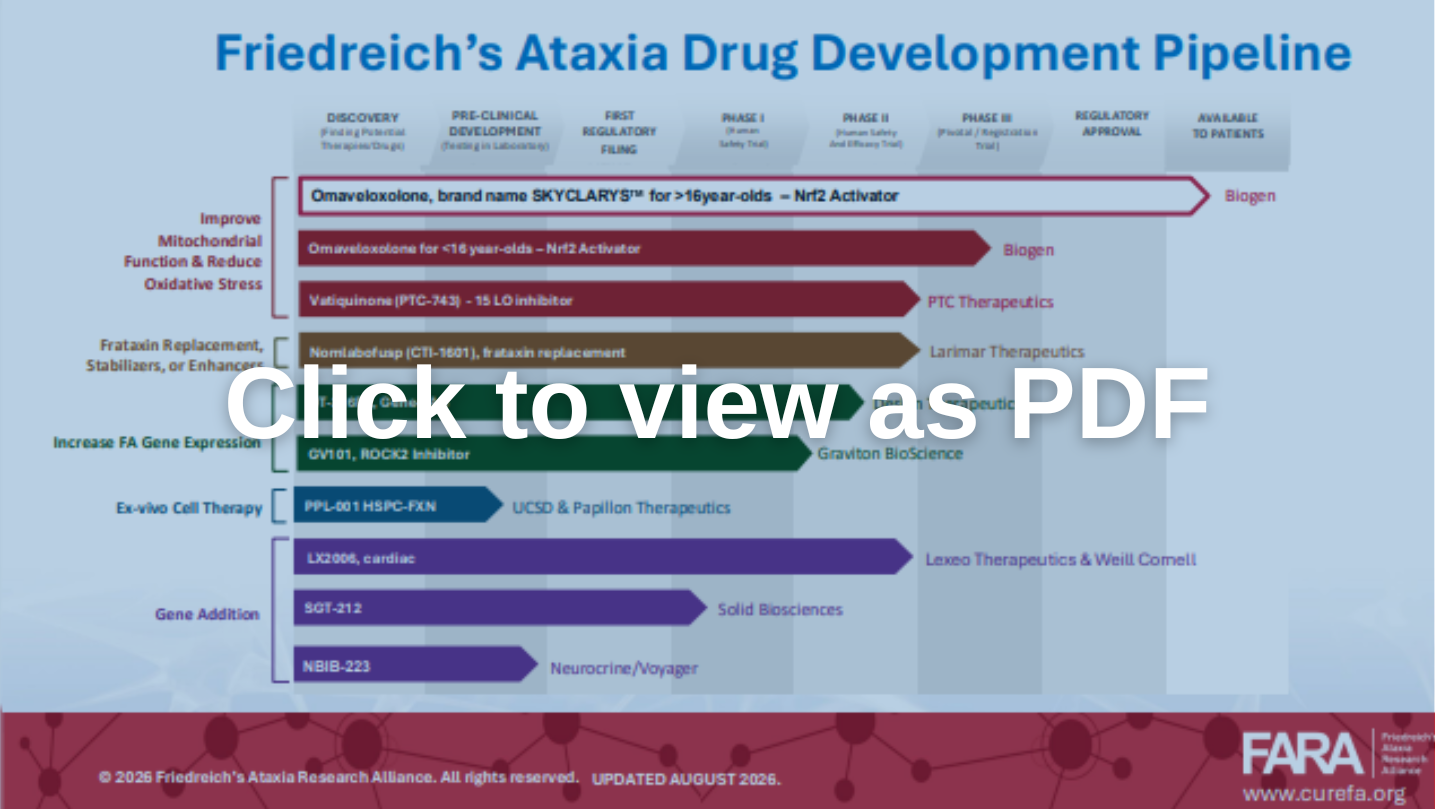
The Friedreich's Ataxia Pipeline is an illustration of the various therapies being developed by FA scientists. On the horizontal axis, each leading drug candidate is represented by its own bar and is grouped by its mechanism of action. Each mechanism of action targets one of the known causes of Friedreich's ataxia.

The milestones for drug development are listed on the vertical axis. For further information on the drug development process and what these milestones mean; please visit the Clinical Trials page, in the Patient & Family Resources section.


Treatment Pipeline


FARA is supporting the advancement of these treatments with financial resources, advocacy, and/ or fostered collaboration. FARA believes that there is merit in each of these approaches and that effective treatment will come in the form of a "cocktail approach"- a combination of two or more therapies.

This pipeline has been updated as of August 10, 2009 and includes research updates presented at the Friedreich's Ataxia Therapeutics Symposium hosted and organized by FARA – July 16 and 17 2009. This pipeline focuses on drugs that are already in human trials or in preclinical development it only represents a small sampling of earlier-stage (discovery) research ongoing to develop and identify new potential therapies.

Drug - Idebenone
Sponsor: Santhera Pharmaceuticals
On May 19, 2009 Santhera announced that the phase III trial of Idebenone (Catena®) in the United States did not demonstrate benefit at the level of statistical significance. The study did demonstrate that the drug was safe and well-tolerated. The company is hopeful that data from the extension study (in which all phase III participants are offered high-dose Catena® for one additional year) combined with data from the European phase III Catena® trial (twice as long, has three times as many patients and involves mostly adults) will demonstrate a level of efficacy so the drug can be submitted for approval as a treatment for FA. The U.S. trial did show that Catena® seems safe and well tolerated and that the patients taking Catena® improved their scores more than those on placebo.

Catena® does have conditional approval in Canada. Santhera has informed FARA that they are making every effort to communicate with Canadian physicians and regulatory agencies to ensure that individuals currently taking Catena® continue to have access to the drug until the additional results from both studies are available.

Santhera press release

Drug - A0001
Sponsor: Penwest Pharmaceuticals
A0001 is the compound discovered by Edison Pharmaceuticals that shows such promise of improving mitochondrial function (energy production) in FA patients and other patients with mitochondrial dysfunction disorders. Edison licensed A0001 to Penwest Pharmaceuticals for the purposes of advancing A0001 through clinical trials. Penwest team initiated phase I of the A0001 trial in July 2008.

On July 17th 2009 at the FA Therapeutics Symposium, Penwest Pharmaceuticals announced the results of its Phase I clinical trials of A0001 Penwest press release. "Based on these results, Penwest plans to advance A0001 into Phase IIa studies in patients with mitochondrial diseases. The Company intends to commence two Phase IIa trials - one focused on patients with Friedreich's Ataxia and the second focused on patients with the A3243G mitochondrial DNA point mutation associated with the 'MELAS' syndrome - in the fourth quarter of 2009. The Company expects data from both of these trials in the first half of 2010."

Drug - Egb-761
Sponsor: Ipsen
EGb 761 is an extract of Ginkgo biloba leaves that has antioxidant properties as a free radical scavenger and is being developed by Ipsen under the name Tanakan®. This drug was initial developed to treat symptoms of age-related cognitive impairment and neurosensorial disorders such as vertigo, tinnitus, hearing loss, and retinal disorders.

Ipsen is conducting a clinical trial of EGb761 in France – "A Phase II, Randomised, Double Blind Study Assessing the Efficacy of EGb761 120mg Bid Versus Placebo in Patients Suffering From Friedreich Ataxia" They are recruiting individuals with FA between the ages of 12 - 22 years and who are ambulatory. More information on the study can be found at the clinical trials.gov website

Drug - Pioglitazone
Hôpital Robert Debré, France
Dr. Pierre Rustin has proposed investigation of Pioglitazone, a prescription drug commonly used in the treatment of type II diabetes, as a potential treatment for FA. In addition to working through insulin pathways, pioglitazone, a well known PPAR y (peroxysome proliferators-activated receptor y) ligand induces the expression of many enzymes involved in the mitochondrial metabolism, including the superoxide dismutases. This agent may be therapeutic by counteracting the disabled recruitment of antioxidant enzymes in FA patients. Pioglitazone has been shown to possibly act on neurodegeneration in human and animal models thus it appears a promising agent to be tested in Friedreich ataxia.

Dr. Rustin has initiated a proof of concept trial in France to explore the effects of Pioglitazone on neurological function in FA patients. They are looking for patients less than 22 years of age. Patients will be treated two years and will undergo clinical exams and testing during two days each six months at the clinical investigation center. Of note, individuals with Type I diabetes and those at risk for congestive heart failure should not take pioglitazone.

Drug - Deferiprone
Sponsor: Apopharma
A phase II study of Deferiprone (iron chelator) was initiated at a number of international sites such as France, Belgium, Italy, Spain, Canada and Australia in mid 2008 and is estimated to conclude July/August 2009. This trial is based on very promising results in a pilot study conducted in France and published last year by Boddaert et al in Blood. This trial was not able to occur in the United States due to an FDA decision that put the Deferiprone trial on hold in the United States.

Results from the Phase II study are anticipated during the fall of 2009. In addition to this clinical trial, the additional animal studies requested by the FDA are being considered so that U.S. patients will be able to participate in subsequent studies.

Drug - Erythropoietin (EPO)
EPO is a hormone produced in our bodies and is also an approved drug used to increase red blood cells. It is commonly used in dialysis and cancer patients as well as in patients just prior to surgery in which loss of blood is anticipated. Austrian researchers Drs. Scheiber-Mojdehkar and Sturm found that EPO increases frataxin levels and last year, along with Dr. Boesch completed very promising proof-of-principle studies in FA patients (see article). In Italy, several researchers have been investigating how EPO may be affecting frataxin levels as well as performing clinical trials. The mechanism is still not understood however these researchers have concluded that EPO does not appear to directly affect frataxin levels genetically (increasing transcription). Based on these initial results there has been interest in conducting larger more definitive trials of EPO. FARA has been working with clinicians in our Clinical Research Network at the University of Rochester and in Melbourne, Australia to finalize preparations for such a trial and, along with these clinicians, we have been looking for a funding partner to share the costs of such a trial with FARA.

Drug - Histone Deacetylase inhibitors (HDACi)
Sponsor: Repligen
HDAC inhibitors are the compounds discovered for FA by Dr. Joel Gottesfeld of The Scripps Research Institute in La Jolla, California. These HDAC inhibitors act at the DNA/gene level and increase frataxin in cells from FA patients and in FA animal models. The Repligen Corporation has licensed these HDAC inhibitors from Scripps for the purposes of advancing them through preclinical development and clinical trials in FA. Repligen and Dr. Gottesfeld are working very closely together, with support from FARA, MDA and GoFAR, and with the FA mouse-model investigators so as to develop the very best HDAC inhibitor for FA, take it to the FDA later this year and into clinical trials as soon as possible thereafter.

Drug – Varenicline (Chantix®)
Sponsor: FARA (Drug is being provided for the trial by Pfizer)
Dr. Theresa Zesiewicz of the University of South Florida noticed that the uncoordinated movements (ataxia) and balance problems in a patient with fragile X tremor /ataxia syndrome improved greatly after he started Chantix® in an attempt to quit smoking. The symptoms worsened when the medication was discontinued. Dr. Zesiewicz found similar results when treating patients with other types of ataxia, including Friedreich's ataxia, and several of her case reports have been published in medical journals.

A new clinical study, sponsored by the Friedreich's Ataxia Research Alliance (FARA), began in June 2009 to investigate whether varenicline (Chantix®) improves neurological symptoms, such as balance, coordination, and sensory perception, all of which are significantly impaired in patients with FA. This study will also evaluate the safety of Chantix® in patients with FA. The double blind, randomized, placebo-controlled pilot study will be led by principal investigator Dr. Zesiewicz, at the University of South Florida College of Medicine, and co-investigator Dr. David Lynch, at Children’s Hospital of Philadelphia. The study is being conducted in two phases. In the first phase subjects and investigators will blinded, meaning that they will not know who is getting the active drug and who is getting placebo. In the second phase all subjects will receive active drug.

For more information on this study – "Double-Blind, Randomized, Placebo-Controlled Pilot Study of Varenicline in the Treatment of Friedreich's Ataxia" - go to: CureFA.org/ChantixStudy.pdf or The FARA Patient Registry

We do not recommend that individuals with FA try Chantix® now. We strongly encourage people to wait for results of the clinical trial and until we understand how this drug might be working.

TAT-Frataxin
Dr. Mark Payne, who discovered and is developing this exciting prospect for FA therapy, presented data from his continued testing of his approach in the FA mice. He makes synthetic frataxin protein and uses a unique delivery system (a protein fragment called a Trans-Activator of Transcription or TAT) to get the frataxin protein to the mitochondria of the FA mice. Dr. Payne’s approach is working extremely well in the FA mice, increasing their average life span significantly. Dr. Payne is now working with a first-rate pharmaceutical company that specializes in protein delivery. The plan for Dr. Payne and the pharmaceutical company is to complete the testing in FA mice as soon as possible and proceed to preclinical drug development.

Additional Approaches - TAT-frataxin, Iron-sulfur clusters, High Throughput Screening
Throughout the research pipeline are other early stage research studies that are focused on discovery of new treatments. We believe that we need multiple shots on goal in various areas to ensure successful treatments are delivered to all patients with FA. For example, on the far right of the pipeline are drug discovery studies using a technology called high throughput screening. Each of these studies is different in that the researcher has developed an assay to measure a desired outcome (e.g. improved mitochondrial function, increased frataxin, etc.) and the assay is then used to screen large libraries of compounds to identify "hit compounds" or new drug targets.