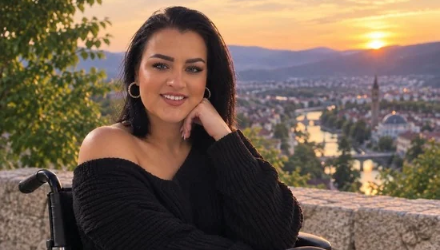
Name:
Elmana Sinanović
Age:
36
Where do you live and how old are you?
I live in Bosnia and Herzegovina. My city is Zenica, and the village where I live is called Vranduk. I grew up here; My family lives here, and I am building my life here.
Who do you live with and who is your greatest source of support?
I live with my parents and they have dedicated part of their lives to me. They are my support system and the reason I never stop believing in a better tomorrow. As far as I know, I have no other family members diagnosed with FA. When things are difficult, my family and talking to people who understand what I am going through help me the most. I reflect on everything I have been through and on the many times I found strength when I thought I had none. Faith, family, and hope for medical progress give me the strength to keep going.
What was the onset of the disease like and what changes did you have to make in your life?
At first, I experienced difficulties with balance and movement coordination. Things that used to be simple, like walking, became increasingly difficult and required much more effort and caution. I gradually lost stability while walking and the moment came when a wheelchair became necessary. It took time for me to accept this change, which was one of the hardest parts of my life. For me, the wheelchair represented facing a new reality, but at the same time, it provided me with greater safety, mobility, and the ability to participate in life. Today, I know that a wheelchair does not mean the end of my freedom. It is a part of my life and a tool that enables me to move forward.
Since I use a wheelchair I need assistance with daily activities. The disease has significantly impacted my mobility and independence. That was the moment that changed my life and my outlook on the future. There were many questions, fears, and uncertainties. At the time, I didn’t fully understand what this diagnosis meant or how the disease would progress. Over time, I learned to live with it, accept the changes, and find ways to continue pursuing my goals.
How did you find out you had FA?
I noticed the first symptoms in high school and I was diagnosed at the age of 23. Many years have passed since then, during which I have faced various changes and learned how to live with this disease. The initial symptoms of FA were related to balance and movement coordination issues. As the difficulties persisted, years of medical tests and examinations followed before I finally received a diagnosis. At first, the difficulties were less pronounced; I could walk, though with some difficulty. Today, my daily life and activities are adapted to living in a wheelchair. Many things require the assistance of others.
What is your day like?
My day depends on my health and my obligations. I dedicate part of the day to myself and my own needs and another part to communicating with people and working on association activities and projects related to the rights of persons with disabilities. I love being active on social media, creating content, and sharing my experiences of living with FA. I am involved in activities for young people with disabilities and enjoy gatherings where we exchange experiences and support one another. My life might look different from that of other women my age, but it is filled with people, ideas, aspirations, and plans.
What do you do to stay active?
I adapt my physical activity to my capabilities and health condition. It is important for me to maintain my mobility and strength as much as possible, following expert advice. For me, activity isn’t just physical exercise; it’s also about learning, communication, creativity, and feeling like part of society.
What has FA taught you?
FA changed my life, but it also taught me many lessons. It taught me patience, empathy, and not to take for granted the little things that make life beautiful. I have become more attuned to the needs of others and more determined to advocate for the rights of people with disabilities. Through living with FA, I have met wonderful people—others going through similar experiences—and found my voice in the fight for a more accessible and equitable society. I wouldn’t say I am grateful for the disease itself, but I am grateful for the strength, the people and the experiences I have encountered along the way.
What advice would you give to people with FA?
My favorite motivational quote is: “My diagnosis is part of my life, but it will never be my whole story, because I have FA, but FA does not have me.” Connecting with people who understand my experience gives me a sense of belonging and security. My advice is to give yourself time to accept the diagnosis; you don’t need to have the answers to every question right away, nor do you have to be strong every single day. Seek support, connect with others living with FA, talk to professionals, and educate yourself about treatment and support options. Don’t stop dreaming, loving, socializing or making plans. You might do some things differently than you had imagined, but you still have the right to a fulfilling life.
Tell us a little more about yourself.
I enjoy being involved in social activities, socializing with other people with disabilities, and participating in workshops and gatherings. I love social media, photography, content creation, and connecting with people. Lately, I’ve wanted to share more of my story on TikTok and Instagram—specifically about life as a woman with a disability, the daily challenges, and the beautiful moments, too. I want people to get to know me as a person with dreams, a sense of humor, interests and a life beyond my diagnosis. My most important piece of advice is to plan my day in advance and not waste energy on things that can be organized more simply. I’ve learned that asking for help isn’t a sign of weakness. It’s important to adapt your environment to your needs and use assistive devices that enable greater independence.
What does finding a therapy mean to you?
For me, a successful therapy would mean much more than just medical progress. It would mean more freedom, less reliance on others for help and more time to actually live my life. Above all, I would love the chance to regain my independence in daily life. I also want therapy to be accessible to everyone with FA, regardless of where they live or their financial situation.
How do you think society should treat people with disabilities?
People with disabilities aren’t less valuable; we don’t need special privileges, just equal opportunities. It’s important to speak directly to the person, ask if they need help, and respect their decisions. I want to live in a society where a wheelchair is not a reason for exclusion, but rather where every person is enabled to live with dignity.
Are doctors in BiH familiar with cases of FA, and do you receive any support from the system?
There are specialists in Bosnia and Herzegovina who deal with neurological and rare diseases, but knowledge and expertise regarding rare genetic diseases need to be further improved. Since FA is a rare disease, those living with it often have to seek out information on their own and connect with other patients, international centers, and research initiatives. People with rare diseases should not be left to fend for themselves. The availability of modern therapies for FA is a particular issue; for instance, the therapy Skyclarys is not available to me as a patient through health insurance in BiH. Access to treatment should not depend on which country someone lives in or how much money their family has. We need systemic support.
Is there a particular topic you would like to emphasize?
I do not want to be defined by my FA diagnosis; I am someone’s daughter, sister, aunt and friend—a person with my own dreams, desires and goals. I want my story to show that a life with a disability can be fulfilling, beautiful, and worth living. Living with FA has taught me the importance of having support but also the importance of fighting for one’s rights. I particularly advocate for accessibility, personal assistance, equality and greater visibility for women with disabilities. I want disability to be discussed openly, without pity or prejudice. My wish is for society to become a place where people with disabilities can live freely, make their own decisions, work, start families, and pursue their dreams. I would like my story to offer support to others with FA, especially those who have just received their diagnosis. I want them to know they are not alone and that their worth never depends on a diagnosis or their ability to move.
How has FA affected your relationships with others and your experience with the world around you?
My life with FA involves physical, emotional and social barriers. Architectural obstacles, inaccessible facilities, a lack of personal assistance, and limited treatment options pose particular challenges. FA has changed some relationships in my life and taught me that true support is about much more than just kind words. Sometimes, people see a person in a wheelchair solely through the lens of their limitations. I have faced situations where I encountered inaccessibility.
What are you particularly proud of and where are you focusing your goals?
I want to see more employment opportunities for people with disabilities in the future. I am proud of the chances I have to speak about my life, participate in public activities, and raise awareness about the needs of people with disabilities.
What is your life goal?
My life goal is to keep learning, developing my abilities and remaining an active member of society. I want to continue advocating for the rights of people with disabilities and raising awareness about Friedreich’s ataxia. FA has affected my capabilities and daily functioning but it has not extinguished my ambitions. I want to show that people with disabilities possess knowledge, ability and ideas and have much to offer society.
My message to everyone is:
“Do not look at my wheelchair. Look at me—at my dreams, my abilities and everything I can offer this world. I have Friedreich’s ataxia, but above all, I am a person who wants to live, love, create, and leave a mark.”
Interview by
Dragana Zagorac
Edited by
Jamie Plourde